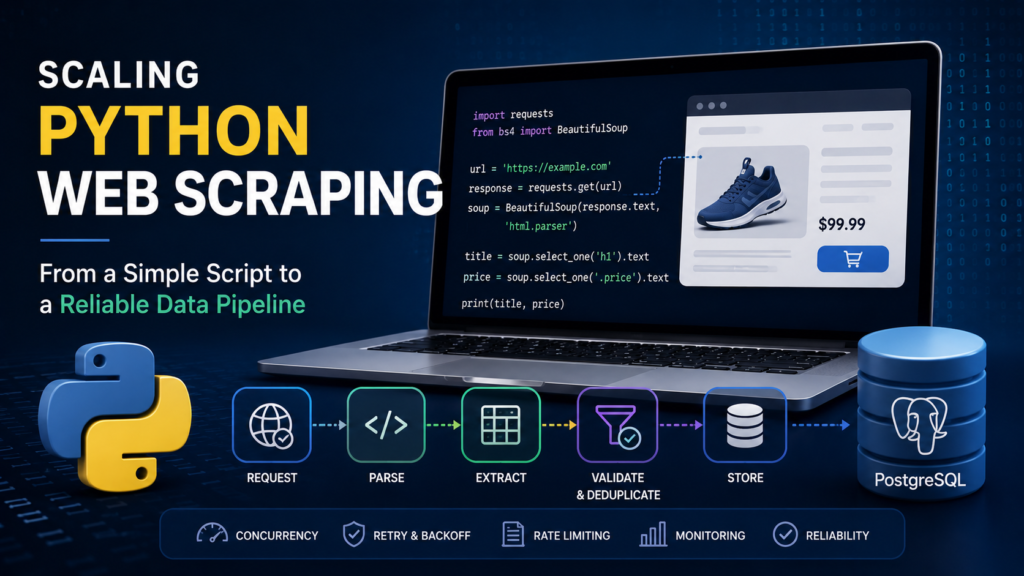
A scraper that works on ten pages is not automatically a system that will work on ten thousand. The difficult part of production web scraping is rarely the first HTTP request or CSS selector. The real engineering work begins when sources become inconsistent, JavaScript appears, requests fail, rate limits tighten, duplicate records accumulate, and a job must run unattended for days without silently corrupting data.
I have found that the most useful way to scale scraping is to stop thinking of it as a single script and start treating it as a data pipeline. Fetching HTML is only one stage. Scheduling, extraction, validation, persistence, observability, and recovery all need explicit responsibilities. This article walks through that evolution and the trade-offs behind it.
1. Start with the simplest useful scraper
For a small, mostly static site, Requests and BeautifulSoup are often enough. Keeping the first version simple makes selectors and data requirements easy to verify before adding infrastructure.
import requests
from bs4 import BeautifulSoup
def scrape_product(url: str) -> dict:
response = requests.get(
url,
headers={“User-Agent”: “Mozilla/5.0”},
timeout=15,
)
response.raise_for_status()
soup = BeautifulSoup(response.text, “html.parser”)
return {
“title”: soup.select_one(“h1”).get_text(strip=True),
“price”: soup.select_one(“.price”).get_text(strip=True),
“url”: url,
}
Even here, two production habits matter: always set a timeout and fail explicitly on bad HTTP responses. A request that can hang forever is not a reliable building block.
2. Know when the script has become a pipeline
Scaling pressure usually appears in several forms at once: more URLs, deeper pagination, heterogeneous page templates, dynamic rendering, retries, proxy or session requirements, and a need to resume after failure. At that point, one large loop becomes difficult to reason about.
- Discovery: determine which URLs should be visited and when.
- Fetching: obtain the response with appropriate headers, sessions, limits, and timeouts.
- Extraction: convert raw HTML or rendered DOM into structured records.
- Validation: reject or quarantine incomplete and malformed records.
- Deduplication: prevent the same logical entity from being stored repeatedly.
- Persistence: write idempotently to durable storage.
- Observability: measure throughput, errors, latency, retries, and data quality.
Separating these concerns is what makes failures diagnosable. If a selector breaks, it should not look like a database problem; if a database is slow, workers should not silently lose fetched pages.
3. A production-ready architecture
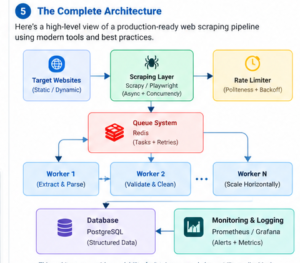
A useful architecture is a scheduler feeding work to a bounded worker pool, with failed work re-queued according to policy. Processed records pass through validation and deduplication before persistence. Logging and metrics observe every stage.
Figure 1. Reference architecture and article layout concept for a scalable scraping pipeline.
The exact technologies can change. Redis may be replaced by another queue and PostgreSQL by another durable store. The important design property is that work has an explicit state and can be retried without creating duplicate output.
4. Concurrency: increase throughput without losing control
Most scraping workloads are I/O-bound, so concurrency can improve throughput dramatically. But unlimited concurrency usually creates a different problem: connection exhaustion, throttling, memory pressure, or unnecessary load on the target.
from concurrent.futures import ThreadPoolExecutor, as_completed
import requests
def fetch(url):
r = requests.get(url, timeout=15)
r.raise_for_status()
return url, r.text
with ThreadPoolExecutor(max_workers=12) as pool:
futures = [pool.submit(fetch, url) for url in urls]
for future in as_completed(futures):
url, html = future.result()
process(url, html)
The worker count should be a measured operational setting, not a contest to maximize requests per second. Scrapy is particularly useful when crawling many linked pages because its scheduler, concurrency controls, request lifecycle, and pipelines already model this problem.
5. Rate limiting is part of reliability
Responsible scraping is not only an ethical consideration; it also improves stability. Respect the site’s terms and access policies, avoid unnecessary traffic, and honor robots.txt where applicable. A scraper that repeatedly triggers throttling is usually poorly controlled.
import random
import time
def polite_delay(base=1.0, jitter=0.6):
time.sleep(base + random.random() * jitter)
For larger crawls, use per-domain concurrency and rate limits rather than one global delay. Back off when a server signals overload or throttling, and do not attempt to bypass access controls.
6. Treat retries as policy, not a reflex
Temporary DNS failures, timeouts, 429 responses, and some 5xx responses are retryable. A 404 or a permanently invalid request usually is not. Retrying everything wastes resources and can amplify an outage.
import random
import time
import requests
def fetch_with_backoff(url, attempts=4):
for attempt in range(attempts):
try:
r = requests.get(url, timeout=15)
if r.status_code == 429 or 500 <= r.status_code < 600:
raise requests.RequestException(f”retryable {r.status_code}”)
r.raise_for_status()
return r
except requests.RequestException:
if attempt == attempts – 1:
raise
delay = min(30, 2 ** attempt) + random.random()
time.sleep(delay)
At scale, failed tasks should carry attempt counts and failure reasons. Once the retry budget is exhausted, move them to a dead-letter or review queue rather than looping forever.
7. Use Playwright only where rendering is actually required
A common scaling mistake is launching a browser for every URL. Browser automation is powerful, but it is substantially more expensive than an HTTP client. First inspect the page’s network behavior: sometimes the structured data is available through an endpoint that can be accessed legitimately without rendering the entire UI.
from playwright.async_api import async_playwright
async def fetch_rendered(url):
async with async_playwright() as p:
browser = await p.chromium.launch(headless=True)
page = await browser.new_page()
await page.goto(url, wait_until=”networkidle”, timeout=30000)
html = await page.content()
await browser.close()
return html
When rendering is necessary, reuse browser instances and contexts where appropriate, cap concurrent pages, and monitor memory. A hybrid pipeline can send static pages through Scrapy or Requests and only route genuinely dynamic pages to Playwright.
8. Validation and deduplication protect the dataset
A pipeline can be technically healthy while producing bad data. Selectors change, optional fields disappear, and pages sometimes return challenge or error content with HTTP 200. Validate the record, not just the response.
from dataclasses import dataclass
from decimal import Decimal
@dataclass(frozen=True)
class Product:
source_id: str
title: str
price: Decimal
url: str
def validate_product(item: dict) -> Product:
if not item.get(“source_id”) or not item.get(“title”):
raise ValueError(“missing required product identity”)
price = Decimal(str(item[“price”]))
if price < 0:
raise ValueError(“invalid price”)
return Product(
source_id=item[“source_id”],
title=item[“title”].strip(),
price=price,
url=item[“url”],
)
Choose a stable natural key such as a source product ID when one exists. Otherwise use a carefully designed composite key or content fingerprint. Deduplication should be deterministic and should happen before downstream consumers treat records as new.
9. Make persistence idempotent
Retries are unavoidable, so database writes must tolerate the same task running twice. PostgreSQL works well for many structured scraping pipelines because unique constraints and UPSERT semantics make idempotency straightforward.
INSERT INTO products (source_id, title, price, url, scraped_at)
VALUES (%s, %s, %s, %s, NOW())
ON CONFLICT (source_id)
DO UPDATE SET
title = EXCLUDED.title,
price = EXCLUDED.price,
url = EXCLUDED.url,
scraped_at = NOW();
Do not rely only on an application-level ‘does this exist?’ check: concurrent workers can race. Let the database enforce uniqueness. For very large workloads, batch writes and keep raw capture or provenance where auditability matters.
10. Queue-based workers make recovery explicit
Once jobs are long-running or distributed, a queue separates discovery from execution. Redis-backed systems such as RQ, Celery, or Bull-based services can be appropriate depending on the stack. The important questions are operational: Can a task be acknowledged only after success? Can it be retried? Can stuck work be detected? Can priorities be expressed?
A task payload should usually be small – for example, a URL, source identifier, crawl timestamp, and retry metadata. Avoid passing large HTML documents through a queue unless there is a clear reason. Store large artifacts separately and pass references.
11. Monitoring turns silent failures into visible failures
Production scraping needs metrics that answer both system and data questions. I typically care about request success rate, response status distribution, latency, pages per minute, retry counts, queue depth, worker utilization, records extracted, validation failures, and duplicate rate.
Structured logs should include identifiers such as source, URL or task ID, attempt number, and pipeline stage. Alerts should focus on meaningful deviations: a sudden jump in 403/429 responses, extraction dropping to zero, queue age increasing, or a required field disappearing across a large percentage of records.
12. A practical evolution path
You do not need Redis, PostgreSQL, Playwright, and distributed workers on day one. A sensible progression is:
- Start with Requests/BeautifulSoup or Scrapy and prove the extraction rules.
- Add timeouts, explicit errors, logging, and deterministic output.
- Introduce bounded concurrency and per-domain rate limits.
- Add retry/backoff policies and persistent checkpoints.
- Validate and deduplicate records before storage.
- Introduce PostgreSQL or another durable store with idempotent writes.
- Route only dynamic targets through Playwright.
- Move work into a queue when jobs must scale horizontally or survive process restarts.
- Add metrics and alerts before the workload becomes business-critical.
Conclusion
Scaling Python web scraping is less about finding a faster loop and more about designing predictable failure behavior. A reliable pipeline knows what work exists, limits how aggressively it performs that work, distinguishes transient failures from permanent ones, validates what it extracts, writes idempotently, and exposes enough telemetry to explain what happened.
Scrapy, Playwright, Redis-backed queues, and PostgreSQL are useful tools, but architecture should follow the workload. Start with the smallest design that is observable and correct, then introduce additional components only when a real scaling constraint justifies them. That approach produces systems that are easier to operate, easier to debug, and far less likely to fail silently.
| About the Author Muhammad Farooq is an AI Automation Engineer and Python Developer specializing in web scraping, browser automation, AI agents, API integrations, and production automation workflows. He builds practical systems using Python, Scrapy, Playwright, FastAPI, and modern automation tools. Website: https://www.farooq77.com/ |
